
Beyond Artificial Intelligence: The Consciousness Revolution
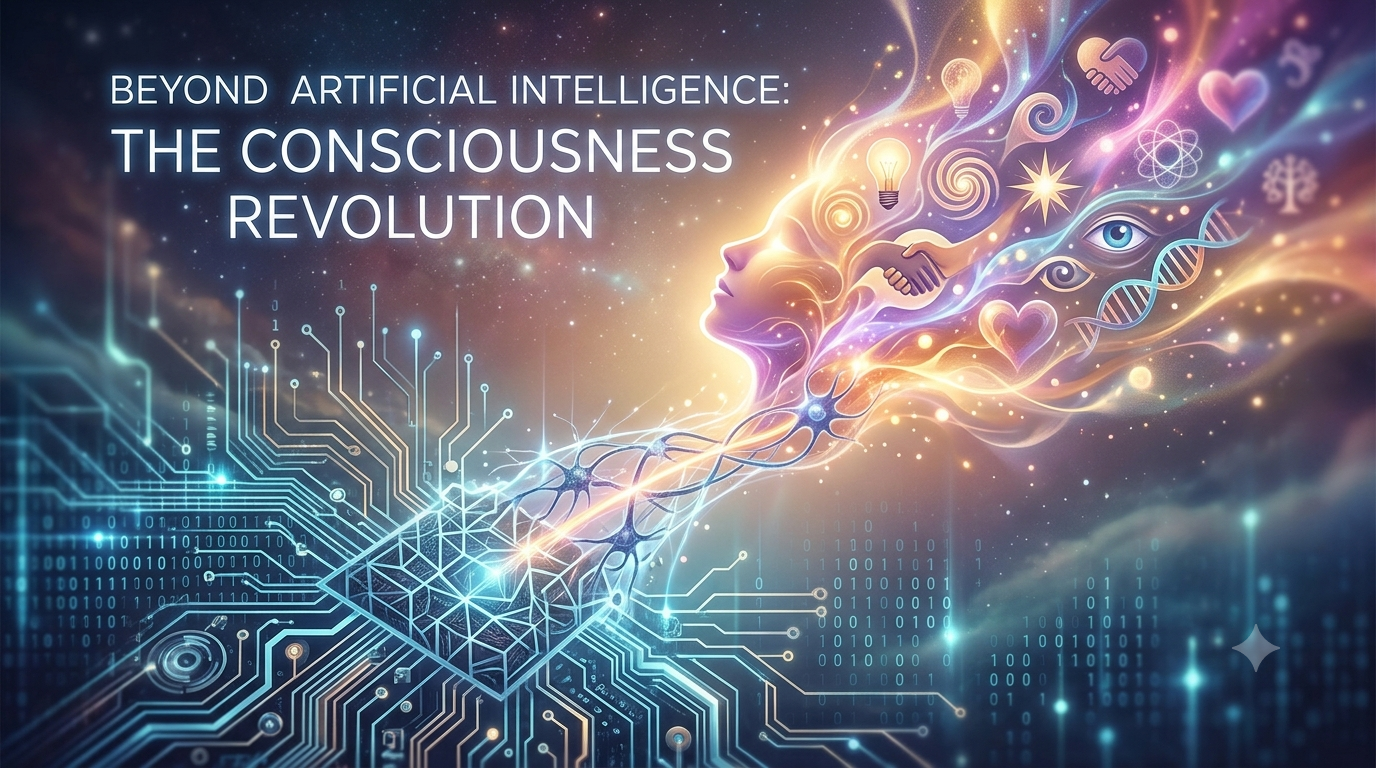
It's time to wake up.
Every so often, humanity arrives at a moment when seemingly unrelated streams of thought begin to converge. What once appeared disconnected suddenly reveals itself as part of a much larger story.
"What I see and believe is that we are living through one of those moments now."
Artificial intelligence is advancing at an astonishing pace, reshaping how we work, communicate, create, and solve problems. At the same time, neuroscience is beginning to illuminate experiences that were once considered the exclusive domain of philosophy and religion. Research into psychedelics and entheogens has re-emerged after decades of dormancy. Mindfulness has found its way from monasteries into hospitals, boardrooms, universities, and military settings. Together, these movements are inviting us to revisit one of humanity's oldest questions.
"What is it to be, to have consciousness?"
Not merely as a philosophical idea, but as a lived experience. Can consciousness mature? Can it be cultivated? And if so, is it possible that the future of humanity depends as much upon the evolution of consciousness, perhaps more so than the evolution of technology?
Intelligence Is Not Enough
For centuries, we have explored the outer world, with adventure and curiosity, with remarkable success. We crossed oceans, harnessed electricity, decoded the human genome, and built machines capable of extraordinary feats of reasoning. Intelligence has become our most celebrated achievement. Yet history reminds us that intelligence alone has never guaranteed wisdom. Some of humanity's greatest advances have also carried the potential for its greatest destruction.
Perhaps our challenge has never been a lack of intelligence.
Perhaps it has been a lack of conscious awareness.
The Ancient Path of Expanded Awareness
Throughout history, human beings have sought experiences that expanded their awareness beyond ordinary waking consciousness. Meditation, prayer, fasting, pilgrimage, music, dreams, ritual, and time spent in nature have all served as doorways into deeper states of perception. Today, scientific research into psychedelic and entheogenic medicines is adding another chapter to this ancient exploration.
When approached responsibly, within appropriate therapeutic and legal settings, these medicines appear capable of temporarily loosening rigid patterns of thought and behavior, allowing many people to encounter themselves in profoundly new ways. Researchers continue to investigate their potential in the treatment of trauma, depression, addiction, anxiety, and existential distress.
Yet those who have walked this path often discover the same truth. The medicine is not the transformation. It is the invitation.
Without reflection, integration, and practice, even the most extraordinary experience can slowly fade into memory. Mindfulness offers a complementary path. Rather than opening consciousness through a single profound experience, it cultivates awareness one breath, one observation, and one moment at a time. One approach may open the door. The other teaches us how to live differently once we have stepped through it.
Can Consciousness Be Cultivated?
As interest in consciousness continues to grow, researchers have also begun asking whether aspects of conscious development can be understood and assessed. Among those contributing to this conversation is Ovidiu Brazdau, founder of the Consciousness Quotient Institute, whose Consciousness Quotient Inventory, or CQ-i, seeks to explore consciousness not simply as an abstract concept but as a developmental capacity that may evolve through experience, reflection, and intentional practice.
Whether one agrees with every aspect of such frameworks or not, they reflect an important shift in our thinking. Consciousness is becoming a legitimate subject of scientific inquiry rather than remaining solely within the realms of philosophy or spirituality.
What AI Makes Us Ask
The emergence of artificial intelligence makes this conversation even more compelling.
Machines are beginning to reason, learn, create, and collaborate in ways that would have seemed unimaginable only a decade ago. As these systems become increasingly capable, they also force us to ask what remains uniquely human. If intelligence can be engineered, perhaps intelligence itself is no longer the highest expression of our humanity.
Perhaps wisdom is.
Perhaps compassion.
Perhaps self-awareness.
Perhaps our capacity to love.
Some researchers are already imagining technological systems that place ethical development, psychological maturity, and wisdom alongside intelligence. Whether these visions ultimately become reality remains to be seen. What they do reveal is that the conversation is changing. We are moving beyond asking how intelligent our machines can become and toward asking how conscious we, ourselves, must become to guide them wisely.
The Consciousness Revolution
"This, I believe, is the real consciousness revolution."
It is not about escaping the world. It is about inhabiting it more fully. It is about remembering that our greatest technology has always been the human mind and heart working together in service of something larger than themselves.
Artificial intelligence may transform civilization.
Consciousness will determine what we choose to do with it. The future, perhaps, belongs not to the most intelligent among us, but to the most awake.
Keith W. Fiveson
Continue with support
See whether this work fits your life
Five short questions can help you notice whether contemplative coaching is a useful next step.
See If This Is For You
Contemplative Coach · Work Mindfulness Institute™
Keith W. Fiveson is a contemplative coach who integrates mindfulness, breathwork, somatic awareness, IFS-informed parts work, and narrative inquiry. His work is coaching and can complement care from a licensed therapist or clinician.