
The Embodied Trinity: Mind, Heart, and Breath
Discovering the Sacred Within Through Awareness, Love, and Spiritus
By Keith W. Fiveson
What if the Holy Trinity is not only a mystery we are invited to contemplate, but also a relationship we can explore through the experience of being alive?
The Christian Trinity names one God in three persons: Father, Son, and Holy Spirit. It is not a doctrine about three organs, three separate gods, or three components of the self. Yet sacred teachings can also invite reflection through analogy. Our embodied lives offer one such possibility.
Consider three dimensions of human experience: the mind that knows, the heart that loves, and the breath that sustains life. Together, they suggest a contemplative way to encounter awareness, compassion, and spirit, not as isolated ideas, but as interdependent aspects of living.
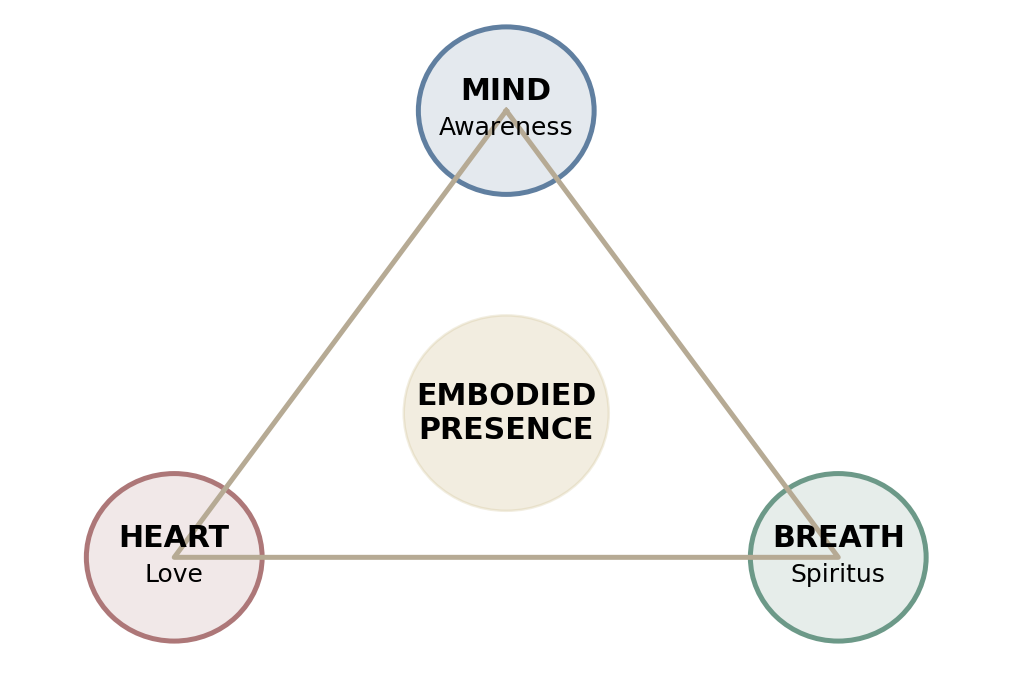
The Mind: Awareness and the Mystery of the Source
In Christian language, the Father is understood as divine source, not simply as a human mind projected onto heaven. As an analogy, the mind points toward our capacity to know, imagine, discern, and create.
But awareness is not the same as thought. We can notice thoughts without being entirely defined by them. We can observe a fear, a memory, or a judgment and discover a little more freedom in how we respond.
Contemplative practice begins with this distinction. The invitation is not to stop thinking, but to become aware of thinking. In that awareness, possibility opens.
Contemplative question: What is it like to notice a thought without needing to follow it?
The Heart: Love Made Visible
In Christian theology, the Son is associated with the Incarnation: divine life entering the full reality of human existence. In our embodied analogy, the heart speaks to love expressed through relationship.
The physical heart does not literally contain all emotion or compassion. Love involves the brain, body, memory, relationships, and choices. Still, across cultures, the heart has long been a meaningful symbol of tenderness, courage, grief, and care.
Love becomes tangible in the way we listen, forgive, repair harm, and accompany another person. Awareness may help us see what is happening. Compassion asks how we will meet it.
Contemplative question: What would love look like as one concrete action today?
The Lungs: Spiritus, Breath, and Participation in Life
The Latin spiritus can mean breath or spirit. Related biblical languages carry similar resonances: Greek pneuma and Hebrew ruach can refer to breath, wind, or spirit, depending on context.
In Genesis 2:7, the breath of life figures in the creation of the human being. In John 20:22, Jesus breathes upon his disciples as he speaks of receiving the Holy Spirit. These are theological images, not scientific descriptions of respiration, but they invite a striking reflection.
Breathing happens largely without our deliberate control, yet we can also attend to it. Every breath depends on an exchange with the world. We receive what sustains us and release what our bodies no longer need.
The breath is not proof of a particular spiritual doctrine. It is an immediate, embodied reminder that life unfolds through relationship and dependence.
Contemplative question: Can I experience one ordinary breath without needing to improve it?
The Kingdom Within and Among Us
In Luke 17:21, Jesus' words about the Kingdom of God have been translated as “within you,” “among you,” or “in your midst.” The difference matters. The Kingdom cannot simply be reduced to a private feeling or an interior psychological state.
Still, the passage invites a profound question: What if spiritual awakening includes becoming more receptive to what is already present, both within our experience and in our relationships with others?
The mind can awaken to awareness. The heart can open to compassion. The breath can return attention to this living moment. In their integration, we may begin to experience the sacred not as an escape from embodiment, but through it.
One Living System, Not Three Separate Parts
The mind, heart, and lungs are not independent. Brain activity, cardiovascular function, respiration, and emotional experience continuously influence one another. Breathing can affect physiological arousal, and our emotional states can alter the rhythm of breath.
This biological interdependence enriches the analogy without proving it. The Christian Trinity is not a map of human anatomy, and no organ corresponds literally to a divine person.
The value of this model lies elsewhere: it reminds us that knowing, loving, and living are inseparable dimensions of human experience.
Awareness without compassion may become detached observation. Compassion without discernment may become reactive or exhausting. Attention to breath can help us return to the present, where a wiser response becomes possible.
A Threefold Practice of Presence
Allow about five minutes. Sit in a position that feels comfortable. Let the breath remain natural. There is no need to hold it, deepen it, or follow a fixed count.
1. Mind: I am aware. Notice sensations, sounds, and thoughts. Rather than trying to clear your mind, recognize what is here. Ask gently: What am I aware of right now?
2. Heart: I am connected. Bring to mind someone or something you care about. Notice what arises, without forcing warmth or emotion. Ask: How might I express care today?
3. Breath: I am alive. Feel the natural movement of breathing. Notice receiving and releasing. Ask: Can I allow this moment to be as it is?
4. Integration: I am present. Rest for a few moments with awareness, compassion, and breathing together. Nothing to achieve. Simply notice your experience.
If focusing on breath feels uncomfortable, rest attention on your feet, your hands, or the sounds around you instead.
From Belief to Lived Inquiry
This interpretation does not replace Christian doctrine or claim that neuroscience can verify spiritual experience. It offers a contemplative lens through which people of different traditions, or no religious tradition, may reflect on being human.
The deeper invitation is practical. Can we know more clearly? Can we love more fully? Can we remain present to the life unfolding now?
Perhaps the most important question is not whether the Trinity can be located in the body. It is whether the body can help us participate more consciously in the mystery to which the Trinity points.
We do not have to leave our embodied lives behind to inquire into the sacred. We can begin with awareness, compassion, and the next natural breath.
Part Two: Spiritus, When Spirit Becomes Flesh
From Inspiration to Aspiration, Respiration, Perspiration, Conspiration, and Expiration
The breath is more than a useful symbol in our exploration of the embodied Trinity. It also appears in the history of words we use to describe how human life unfolds. The Latin verb spirare, “to breathe,” lies behind inspiration, aspiration, respiration, perspiration, conspire, and expire. Their present-day meanings are not identical, and their shared roots do not prove a spiritual theory. Yet their echoes invite a compelling contemplative inquiry: How does what we receive become what we live?
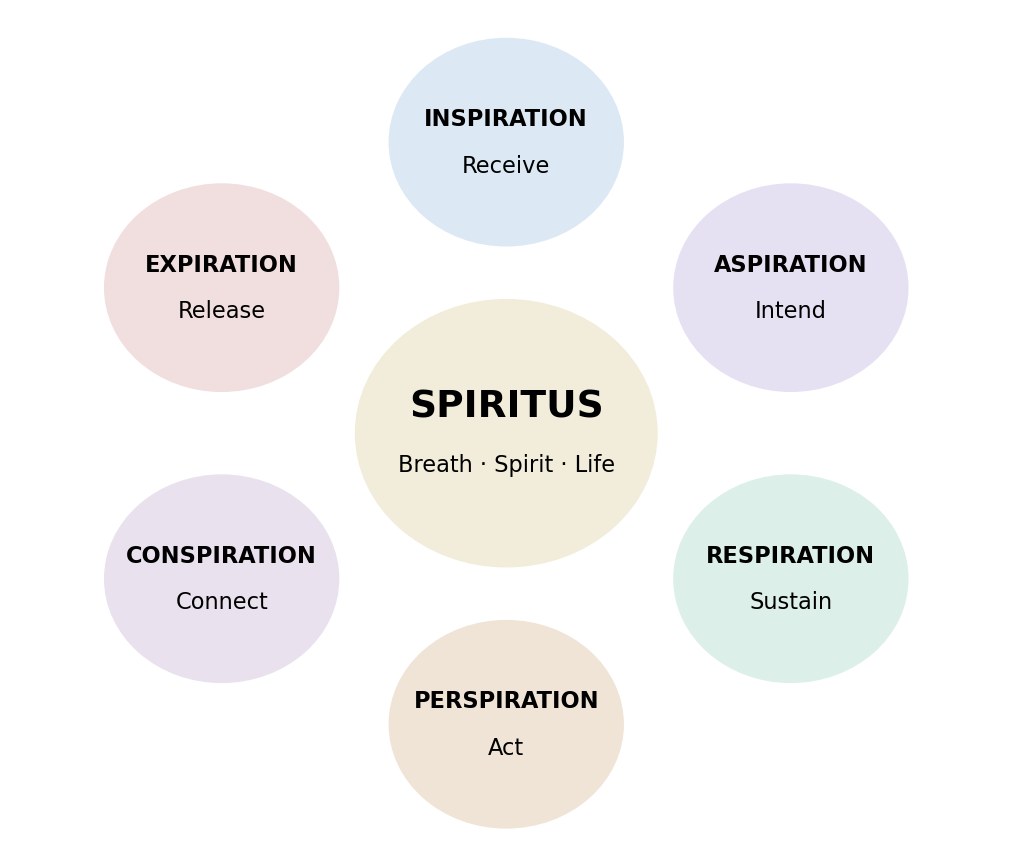
Inspiration: Receiving
Inspiration begins with receiving. We inhale before we can speak. An idea may arrive while walking, listening, grieving, or sitting quietly. We do not always manufacture insight by force of will. Often, we become receptive enough to recognize it.
To be inspired is not yet to be transformed. It is to encounter a possibility. What is asking for my attention?
Aspiration: Intending
Aspiration gives direction to what has stirred within us. We begin to ask what matters, who we wish to become, and how we might respond. An aspiration is not a demand for perfection. It is an intention that can guide the next choice.
What quality do I want to embody today?
Respiration: Sustaining
Respiration is the ongoing biological process that supports life. As contemplative practice, attention to natural breathing can help us notice our experience without rushing to change it. Breathing is not a spiritual achievement, nor is a particular pattern of breathing required for insight.
Can I remain present with what is here?
Perspiration: Practicing
Perspiration reminds us that meaningful intentions require effort. The word has a physiological meaning related to the release of moisture, not a literal definition of spiritual labor. As an analogy, it points to the work of embodying our values: listening when impatient, apologizing after harm, practicing when distracted, and returning when we fall short.
What small action would make my intention real?
Conspiration: Participating Together
The Latin conspirare carries the sense of breathing together, agreeing, or acting in concert. Its familiar English descendant, conspiracy, often means a secret plan to do harm. Here we recover the older image, without ignoring the modern meaning.
Our lives are not lived in isolation. We learn through relationship, and compassion becomes tangible in shared attention, mutual responsibility, and care. In a circle of people who listen and speak with sincerity, we can experience something more than individual reflection.
What becomes possible when we attend and act together?
Expiration: Releasing
To expire can mean to breathe out, to come to an end, or to die. The word invites us to consider mortality without romanticizing it. Each exhalation is a release, but ordinary exhaling is not a miniature death. Rather, the shared language reminds us that life includes change and limits.
We cannot keep every moment, control every outcome, or hold on indefinitely. Acceptance, including the practice of saying “Okay, Even If This,” need not mean approval or resignation. It can mean meeting reality without adding unnecessary resistance.
What might I release without abandoning what I love?
The Word Becomes Flesh: From Insight to Embodiment
John 1:14 declares that the Word became flesh. In Christian theology, this is a claim about Christ's Incarnation, not simply a formula for personal growth. As a contemplative analogy, however, it raises a practical question: What happens when a value takes form in a life?
Consider compassion. We may be inspired by another person's suffering. We aspire to respond with kindness. We return to the present through ordinary breathing and awareness. We do the difficult work of listening or helping. We join others in shared care. And we learn to release our need to control the outcome.
In this sense, spirit becomes embodied when awareness informs intention, love guides action, and our participation in life becomes deliberate. This is an invitation to practice, not a claim that the divine Incarnation and human behavior are the same event.
Returning to Mind, Heart, and Breath
The first part of this teaching describes three interdependent capacities: the mind's capacity to know, the heart's capacity to love, and breath's reminder that we participate in life. The second part traces how an insight can become intention, practice, relationship, and release.
The two diagrams belong together. The triangle describes an integrated experience of presence. The circle describes recurring movements within a human life. Neither should be read as a scientific model or a literal account of the Trinity.
A Practice: From Inspiration to Embodiment
Sit comfortably and let your breath remain natural. If attending to breathing feels uncomfortable, use the sensations of your feet or the sounds around you instead.
- Receive. Notice one insight, feeling, or need asking for attention.
- Intend. Name one quality you want to bring to your day.
- Remain. Spend a few moments attending to your present experience.
- Act. Choose one concrete expression of your intention.
- Connect. Consider who might benefit or participate.
- Release. Let go of the demand to control the result.
Return to this practice as often as useful. These movements need not occur in a fixed order.
An Invitation to Inquiry
From our first breath to our last, human life unfolds through receiving and releasing. In between, we imagine, choose, work, care, and participate with others. The language of spiritus helps us notice these dimensions of experience without reducing spiritual mystery to anatomy or etymology.
What would change if we understood spiritual life not only as something we believe, but as something we practice through how we know, love, breathe, and act?
Keith W. Fiveson is an author, contemplative teacher, and founder of the Work Mindfulness Institute. His work explores mindfulness, trauma recovery, conscious living, and human flourishing.
Editorial note: This two-part essay uses theological and linguistic analogies for contemplative inquiry. It does not equate the human body with the Christian Trinity, offer a medical breathing protocol, or suggest that shared etymology establishes spiritual truth.